Blog · Comparison
Volares vs Clio: running the firm, or doing the work
Clio runs the business of a law firm: matters, billing, trust accounting and payments, with AI alongside. Volares is AI that does the work of each stage of a matter. Many firms need both. Here is how to tell which one to start with.
A five-lawyer family and employment firm has run on Clio for years. The invoices go out on time. The trust account reconciles. Every matter has its folder and its calendar.
And on Monday morning one of the partners is still reading every new enquiry herself, writing the engagement letter from last year's copy with the old client's name carefully removed, and emailing a client for the third time about the payslips.
Nothing is wrong with the firm's software. It is doing what it was bought to do. The hours that are left over are a different kind of hours, and that difference is what this comparison is about.
A disclosure first: we build Volares, so we are not neutral. What we say about Clio comes from Clio's own pages and from reporting on it, linked at the end.
The short answer
If the hours you want back go to billing, trust accounting, time, the calendar and getting paid, that is what Clio Manage is built for, and Volares does not do it. Start there.
If the hours go to the work itself, the first email from a new client, the engagement letter, chasing documents, drafting in the firm's own form and checking the other side's changes, that is what Volares is built for. Start there.
Many firms will end up wanting both: something that runs the business, and something that does the work. The useful question is which one to fix first. One thing to know before you plan on both: Volares does not connect to Clio today.
What Clio is built for
Clio is several products. Clio Manage is practice management: matters, documents, billing, trust accounting, calendaring, time tracking, and payments clients can make online. Clio Grow covers client intake, onboarding and CRM.
On the AI side, Clio Duo is the assistant inside Clio Manage. Clio Work is Clio's AI workspace for legal research, analysis and strategy. It draws on the vLex library Clio acquired in 2025, along with the matter's own files, and since April 2026 it is sold on its own to solo, small and mid-sized firms.
The center of Clio is the business of the firm: the record of what the matter is, who did what, what is owed and what has been paid. It is built for solo and small firms, and those already running Clio have the most reason to look at what it adds.
What Volares is built for
Volares makes law practices AI-native. We bring the platform and a team that owns each firm's workflow with them, end to end. Its center is the work of each stage of a matter, from the first lead to closing and back.
Go back to that Monday. Each firm gets its own intake address, and a client's email opens a lead with a summary of what the client needs, the parties and the urgency, and a first reply drafted in the firm's style for a lawyer to read and approve. When the draft carries a price, a link, a phone number or a promise, the firm's fixed wording is used instead.
The engagement letter is drawn from the firm's own template, after a conflict check, and signed electronically. On signing, the lead becomes a client and the matter opens with the facts from the conversation and the signed letter on it. The client gets an upload link that files straight into the matter, so the payslips land where they belong instead of in someone's inbox.
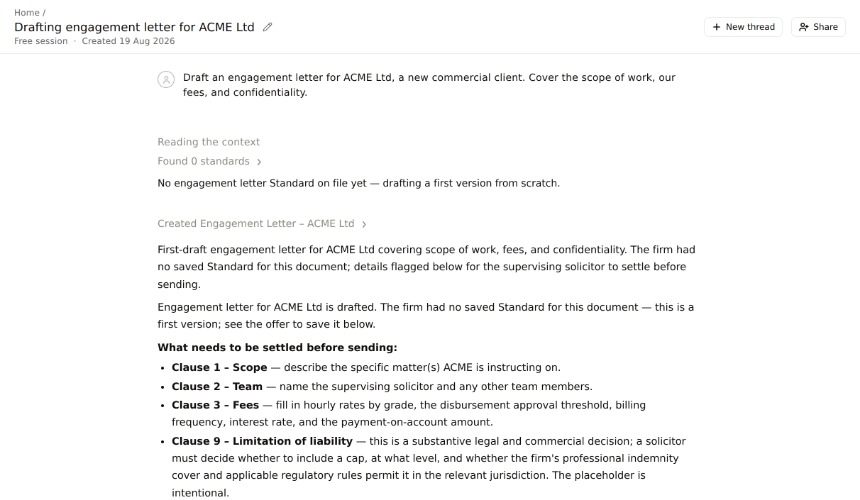
Drafts are written to the firm's own Standard, learned from its own documents. A value the draft does not have is left as a visible gap, not invented, which is what the letter above is doing. Incoming contracts are reviewed against the firm's playbook, every finding citing the clause it came from. And when a matter is done, it is closed from the conversation with its open work listed first; when the client returns, the next matter opens on the same client record.
Every stage can be reached from the firm's own Claude or ChatGPT, not only from Volares' screens. More on that.
Where they overlap, and where they don't
Intake
Both have something here, and they mean different things by it. Clio Grow covers client intake, onboarding and CRM. In Volares, intake is where the work starts: the enquiry is read, summarized and answered in draft, and it runs on into the conflict check, the engagement letter and the opening of the matter. If you already use Grow, ask which of those steps it does for you and which it records.
AI
Clio's AI is split across products: Clio Duo inside Clio Manage, and Clio Work for research, analysis and strategy, drawing on vLex. Ask Clio which features sit in which plan. Volares is AI throughout; it is not a feature added to a system of record. It also does not research case law yet, which is something Clio Work is built for.
Money
This is the cleanest line between them. Clio Manage runs billing, trust accounting, time and online payments. Volares does none of that. It does not collect the client's payment for the firm; a lawyer marks the fee as received.
How to decide
Take last week and sort the hours into two piles. In one, the running of the firm: invoices, trust, time, the calendar. In the other, the work: enquiries, letters, chasing, drafting, reviewing changes.
If the first pile is bigger, or there is no system holding the money yet, start with practice management. That is not a close call. If the second pile is the one keeping lawyers in the office at eight, start with the work, and be clear-eyed that, today, the matters would sit in Volares and the books in Clio, side by side.
Either way, try it on a matter you already know the answer to. Twelve questions to ask before you buy covers the conversation, and the best AI for law practices in 2027 sets Clio and Volares beside seven other products. If you would like to try ours, a pilot runs on your own matters.