The best AI for law practices in 2027
A practice does not need one more chat window. It needs a place for every stage of a matter, from the first enquiry to closing. Here is how we would choose, starting with what we build.
How to choose
Most lists of legal AI rank tools by how well they write. That matters less every year, because the models underneath are converging. What separates the tools going into 2027 is what they are attached to.
Five questions do most of the work. Does it hold the matter, or only the question you typed? Does it cover the stages your practice actually runs: intake, the engagement letter, the client's documents, drafting, review, deadlines and closing? Does it work where your lawyers already are, in Word, in Claude or in ChatGPT? Can you see what it read, and does it say so when it does not know? And who sets it up for your firm: you, or someone who stays?
A disclosure before the list. We build Volares, so it comes first and we are not neutral about it. Everything said about other products below is taken from their own public pages in October 2026, and links to them.
1 · Volares
Best for: small and mid-sized firms that want the whole matter in one place, from the first lead to closing and back, with a team that sets it up with them.
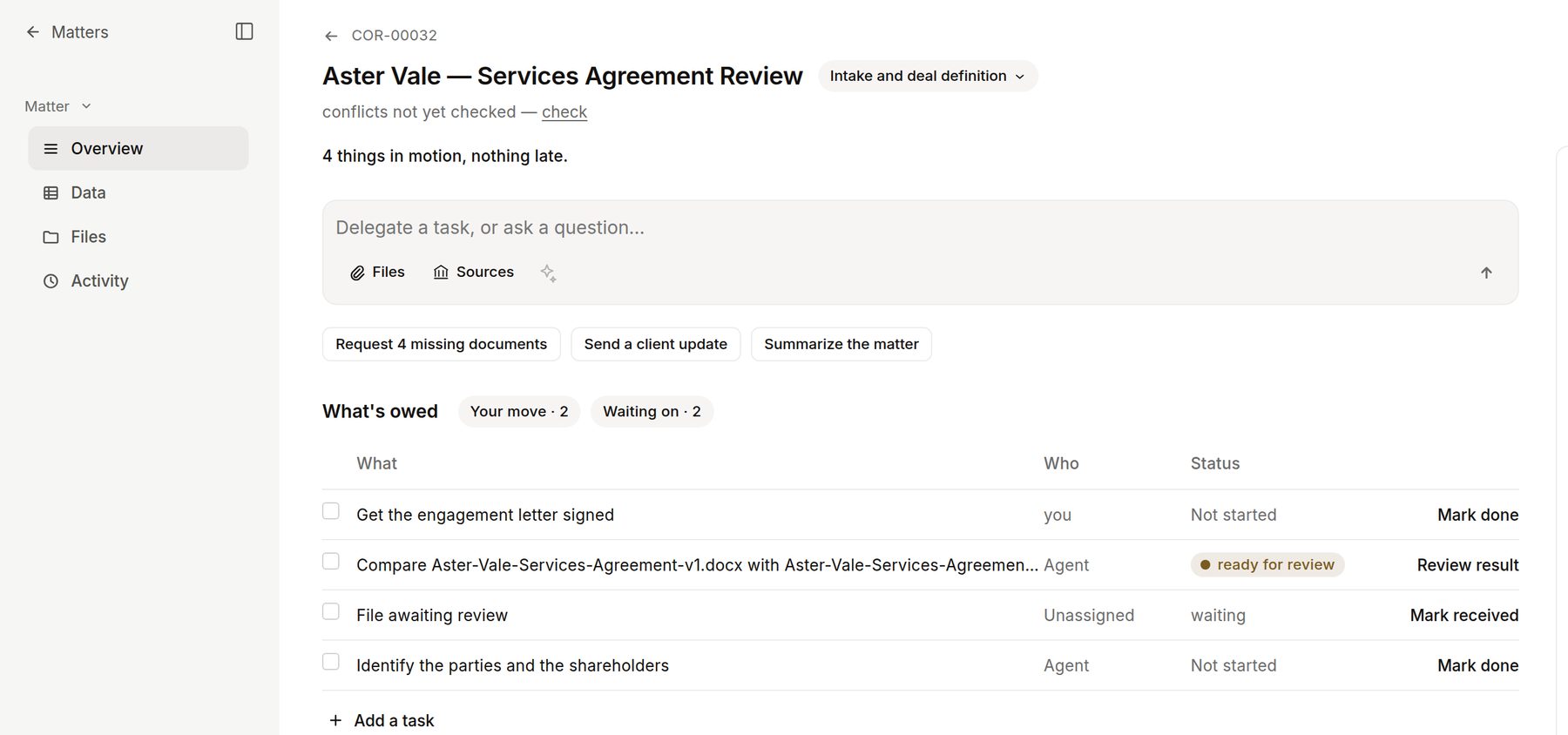
Volares makes law practices AI-native. We bring the platform and a team that owns each firm's workflow with them, end to end. The idea is simple: each stage of how a firm works has a place in Volares, and every stage can be reached from the firm's own Claude or ChatGPT, not only from our screens.
A lead arrives. Each firm gets its own intake address. A client's email opens a lead with a summary of what the client needs, the parties and the urgency, and a first reply drafted in the firm's style for a lawyer to read and approve.
The engagement letter. It is drawn from the firm's own template, after a conflict check, and signed electronically. On signing, the lead becomes a client and the matter opens with the facts from the conversation and the signed letter on it.
The client's documents. The client gets an upload link that files straight into the matter.
The drafting. Drafts are written to the firm's own Standard, learned from its own documents. A value the draft does not have is left as a visible gap, not invented. Incoming contracts are reviewed against the firm's playbook, and every finding cites the clause it came from.
Closing, and coming back. A matter is closed from the conversation, with its open work listed first. When a client returns, the next matter opens on the same client record.
From your own chat. Connect Volares to Claude or ChatGPT and ask about a matter, open a new one after a conflict check, send the client an upload link, or ask what the firm accepts in a clause, from its own playbook.
Every run we describe here was on a demonstration matter. Connect it to your chat, or ask for a pilot on your own matters.
What Volares does not do yet
It does not collect the client's payment for the firm. A lawyer marks the fee as received.
It does not file with a court's system. A person files.
It does not search case law yet, in any jurisdiction. Israel's statutes are searchable, with a link to the Knesset text; precedent is not, yet.
It does not connect to iManage, NetDocuments or Clio today. If your matters live there, that is a real cost, and it belongs in the decision.
2 · Harvey
Best for: large firms and legal departments running high-volume, high-stakes work.
Harvey describes itself as one platform for legal work. Its Assistant answers questions, analyzes documents and drafts; Vault holds large document sets for bulk analysis; Workflows runs pre-built or firm-built processes; and its agents are described as carrying out complex legal tasks from start to finish.
What to check: it is built for large teams, so ask about the minimum team size and contract length before you plan a pilot.
3 · Legora
Best for: firms and in-house teams doing review and research at scale, often across borders.
Legora calls itself "the collaborative AI powering lawyers to review and research faster." Its Tabular Review puts documents in rows and questions in columns, which suits diligence and mass review. Its agent is described as handling end-to-end execution of complex legal work, and Monitors track regulatory change.
What to check: how far it reaches past review and research into the rest of your matter.
4 · CoCounsel Legal
Best for: research-heavy litigation practices already on Westlaw.
Thomson Reuters describes CoCounsel Legal as "agentic AI grounded in deep legal expertise." Its Deep Research builds a multi-step research plan and returns a report with citations, drawing on Westlaw and Practical Law. It also drafts with citations and works inside Word.
What to check: its strength is authority. Ask how much of the rest of a matter, from intake to closing, it is meant to hold.
5 · Lexis+ with Protégé
Best for: firms that research on Lexis and work in Microsoft 365.
Formerly Lexis+ AI, renamed in 2026. LexisNexis says a lawyer describes the goal and the platform picks the models, agents and sources behind it, with answers grounded in LexisNexis content, linked citations and Shepard's signals. Protégé is also available inside Microsoft 365 Copilot and Teams.
What to check: the same question as for CoCounsel. Research and drafting are covered; ask what holds the matter itself.
6 · Clio Work and Clio Duo
Best for: solo and small firms, especially those already running Clio.
Clio Work is Clio's AI workspace for legal research, analysis and strategy. Since April 2026 it is sold on its own to solo, small and mid-sized firms, and it draws on the vLex library Clio acquired in 2025 along with the matter's own files. Clio Duo is the assistant inside Clio Manage.
What to check: which features sit in which plan, since the AI is split across products.
7 · Spellbook
Best for: transactional lawyers who live in Word.
Spellbook calls itself "the complete contract AI suite": review and redlining, drafting, playbooks and a searchable contract repository, designed for law firms and in-house teams.
What to check: it is built around the contract. A practice that is mostly litigation or advice will want something that holds the matter as well.
8 · EvenUp
Best for: personal injury firms.
EvenUp describes itself as an AI platform for the entire personal injury case lifecycle, with tools for each stage from intake to trial, built on what it calls the largest dataset in personal injury.
What to check: it is specialized by design. Outside personal injury, look elsewhere.
9 · Claude and ChatGPT on their own
Best for: thinking a problem through, a first draft, a second opinion.
A general assistant is the cheapest place to start, and the models are very good. What it does not have, on its own, is your firm: the matter, the documents on it, the deadlines, your own forms and positions. It holds what you paste into it and forgets the rest.
What to check: your plan's data terms before any client material goes in. And if your lawyers already work there, connect the firm to it rather than asking them to leave. That is why Volares can be reached from both.
Putting it together
Most firms will run two things in 2027: one that holds the matter, and one that is deepest in research for their jurisdiction. Choose the first by the stages it covers, and the second by its authority.
Whichever you pick, try it on a matter you already know the answer to. A demo shows what a product can do. Your own file shows what it does for you.
This list is written by Volares. What a product elsewhere does is for its own documentation to say; we quote ours, and we link theirs. No prices are given, because the published figures disagree; ask each vendor.