How your Standard controls what the AI drafts
A firm's drafting is its own. The Standard is how that becomes something the software follows rather than something a prompt asks for politely.
The argument
Ask a general model for an engagement letter and you get a competent one. It will not be yours. The clauses your firm argued about and settled three years ago will not be in it, and the ones you removed on purpose will.
The usual answer is to describe the house style in an instruction and hope. That fails in a way worth naming: an instruction is advice, so it holds for the paragraph somebody was watching and drifts on the twentieth document nobody read closely.
A firm's drafting is one of the few things it genuinely owns. It should be a thing the software follows, not a thing it is asked about.
The mechanism
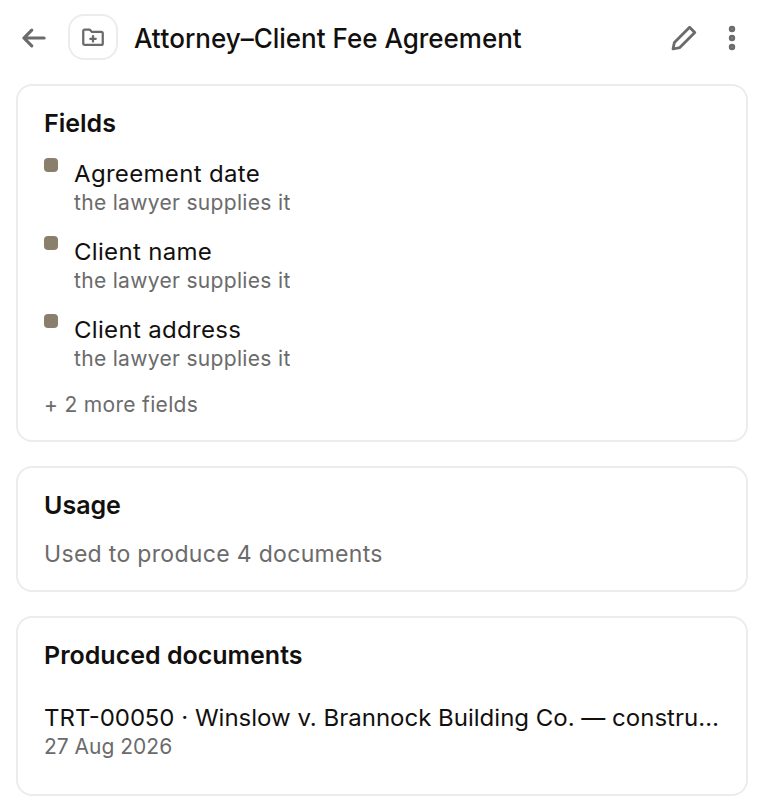
A Standard is taught from a document the firm has already written. You give it one of your own, and what is learned is the structure of that document: its sections, the order they come in, and which parts are fixed text against which parts change per matter.
That happens once. It is not a prompt repeated at the top of every request, and it is not a setting a lawyer has to remember to select. A Standard lives in the firm's library as an object, so it can be opened, read and changed by the people whose drafting it describes.
Drafts are then produced against it. The fixed parts arrive as the firm wrote them. The parts that change per matter are filled from the case record, from the parties and the facts the file already holds, so the draft is about this matter rather than a specimen with the names swapped.
When a document is reviewed rather than drafted, what comes back is tracked changes, in the document, of the kind a lawyer accepts or rejects one at a time. Not a rewritten file to compare by eye, and not a list of suggestions in a separate window.
Everything exports to Word whenever you want it. The Standard produces documents in the format the firm already works in.
What it does not do
It does not invent your house style. A Standard is taught from a document you supply, so a firm with nothing written down has to write something down first. That is a real cost and it is the first hour of the work.
It does not make the draft correct. A Standard governs shape, and whether a clause is right for this matter is a lawyer's judgement. What it removes is the part where a competent draft is competently wrong about your firm.
It does not lock the wording. A Standard is an object in the library rather than a decision taken once and buried. Firms change their drafting, and a Standard that could not change would be a worse version of a template folder.
It does not train anyone's model on your documents. What the firm teaches improves that firm's own drafting and goes nowhere else.